
Supervision at the heart of heavy-truck electrification
Very high power, operational continuity, Tiruert compliance: charging electric heavy-goods vehicles demands supervision that's up to the task. Scheduling, smart charging, alerting and remote-start.

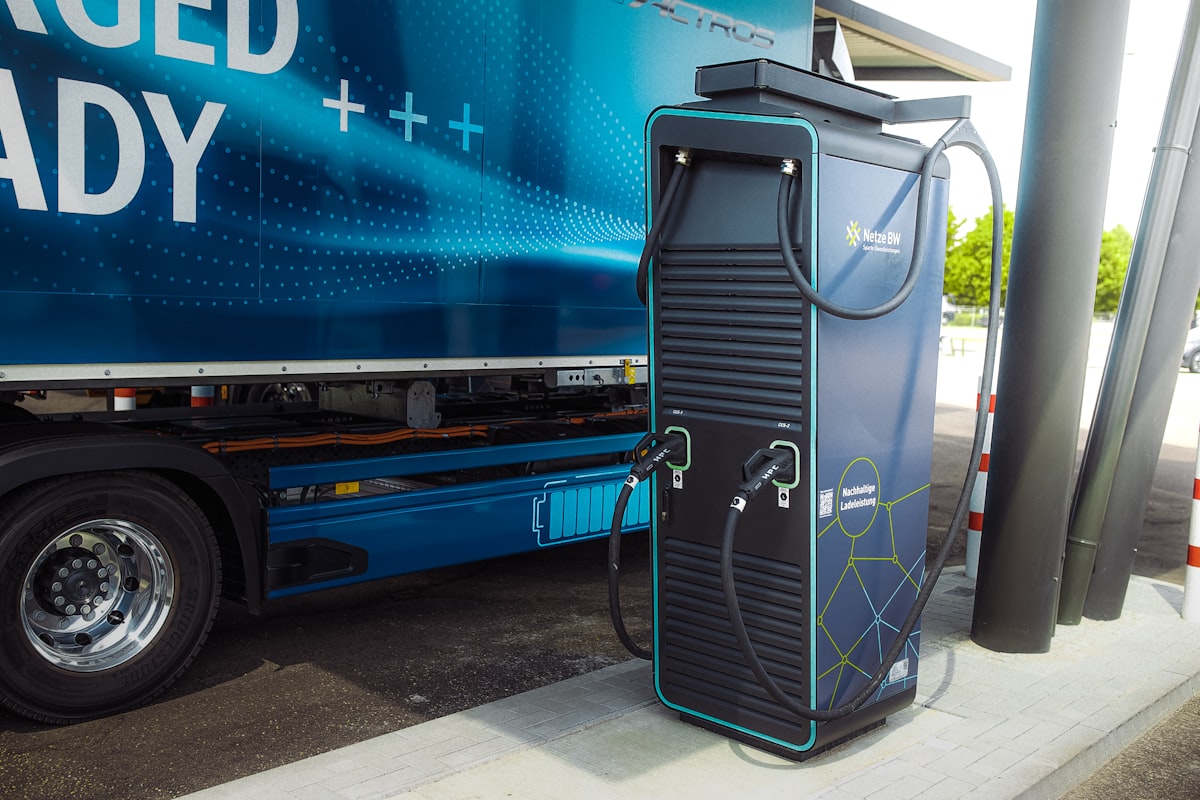
The electrification of road freight transport is no longer a forward-looking scenario: it is now an unavoidable industrial trajectory. Under the combined effect of decarbonisation targets, European regulation and the commitments of major shippers, electric heavy-goods vehicles are beginning to enter service and their deployment will accelerate sharply over the coming years. This transition, however, brings specific constraints far beyond those of light vehicles: very high charging power, strong operational constraints, fleet business continuity and direct dependence on the energy availability of logistics sites and major routes.
Faced with these challenges, the electrification of road freight cannot succeed without close coordination across the entire value chain. Carriers, charge point operators (CPOs), energy companies, e-mobility service providers (eMSPs) and manufacturers must work together to design infrastructure capable of absorbing these new uses, while controlling costs and the impact on the electrical grid.
Since its creation, Chargekeeper has positioned itself alongside operators and carriers to support them through this transformation. By providing advanced supervision, energy management and intelligent charging tools, the platform makes it possible to deploy reliable, cost-effective solutions adapted to the constraints of heavy transport. This article zooms in on the main challenges of charging electric heavy-goods vehicles and the technological levers available to make this transition operational and sustainable.
Charging scheduling: securing fleet operations
In road freight transport, charging cannot be managed as a standard use case. The slightest energy unavailability can jeopardise an entire route, with immediate impact on deadlines, contractual penalties and profitability. Charging scheduling — or depot management — is therefore the central building block of any heavy-truck charging strategy.
Depot management relies on a fine-grained model of real operations. For each vehicle, the operator enters its technical sheet into supervision (battery capacity, admissible charging power, connector type), along with its operational parameters: routes performed, distances travelled, target state of charge (SOC), depot arrival and departure times. This data makes it possible to translate business constraints into precise energy needs.
From this information, Chargekeeper continuously calculates charging needs and automatically orchestrates power distribution across all the site’s charge points. The platform’s algorithms adjust sessions in real time based on priorities, operational contingencies and available electrical capacity, to guarantee that each truck reaches its required charge level before departure without unnecessarily straining the grid.
This approach turns charging into a managed industrial process, natively integrated into logistics operations. The depot is no longer a simple charging point, but an intelligent system able to absorb the complexity of heavy transport while securing business continuity.
Smart charging: controlling the cost per kilometre
Once charging is scheduled, the economic challenge becomes central. For a carrier, energy cost directly impacts the cost per kilometre and, by extension, the competitiveness of the business. Unmanaged charging can quickly trigger demand peaks, exceed the subscribed power level and produce an energy bill that is hard to control, especially at heavily used logistics platforms.
Smart charging dynamically adjusts the power delivered to charge points based on the site’s electrical capacity, grid constraints and pricing opportunities. By smoothing demand and exploiting the most favourable periods — off-peak hours, local energy production, price signals or grid availability — Chargekeeper helps operators sustainably reduce their energy spend.
To address the diversity of uses and operating models in road freight, Chargekeeper natively offers several smart charging scenarios, designed to adapt to field realities: vehicle prioritisation, per-site power limiting, arbitrage between charging and other energy uses.
In addition, Chargekeeper can integrate smart charging mechanisms operated by third parties, in particular electricity suppliers. Through API connections, supervision can delegate all or part of charging control to the energy company, which then adjusts strategies based on its production costs and grid balancing. This interoperability gives carriers maximum flexibility and lets them benefit from optimised energy terms without losing operational control of their infrastructure.
In road freight, this ability to finely steer charging — both internally and through energy partners — is a key lever for making electric viable economically at scale.
Advanced alerting: guaranteeing vehicle availability
In an environment where charging mostly takes place at night or during off-hours, rapid anomaly detection is essential. A session interrupted without an alert can go unnoticed until the critical moment of the vehicle’s departure.
The advanced alerting modules integrated into Chargekeeper make it possible to monitor, in real time, the status of charge points, connectors and charging sessions. In the event of an anomaly — charging stoppage, charge curve deviation, hardware fault, loss of communication — operators are immediately notified by app notification, email and SMS. This real-time visibility turns supervision into a genuine operational safeguard, indispensable to ensuring that trucks leave on time, every day.
Remote-start: automating service continuity
In road freight environments, the ability to automatically handle contingencies is also a critical need. A charging interruption, even a one-off, can jeopardise a vehicle’s availability and disrupt operations.
Chargekeeper offers a remote-start module built on an intelligent, customisable agent that continuously monitors the proper progress of charging sessions. This agent can be configured according to multiple criteria: type of error detected, interruption duration, charge point status, power delivered, vehicle concerned or operational priority. Based on these parameters, it automatically triggers corrective actions, such as restarting the charging session, without human intervention.
This automation secures charging and reduces contingencies to a strict minimum. By limiting unaddressed interruptions and emergency call-outs, remote-start helps guarantee that vehicles reach their required charge level on time. For logistics platform operators, it is a key lever for ensuring business continuity while reducing on-call costs.
Making EV charging infrastructure pay off in heavy transport
With Chargekeeper, operators can open up their infrastructure to partners — other carriers, third-party fleets or operators — in a controlled and secure way. This pooling significantly increases station utilisation rates, maximises the volume of kWh delivered and turns infrastructure initially seen as a cost centre into a genuine value-creation lever.
This opening up can take place via several models, depending on the targeted uses and ecosystems. Chargekeeper enables both direct peer-to-peer connections with third parties, facilitating interoperability between supervision platforms, and the integration of roaming contracts via recognised hubs such as Gireve. The platform can also interface with solutions dedicated to transport and energy procurement, developed specifically to support the electrification of heavy-truck fleets. This flexibility gives operators the freedom to build open, scalable operating models aligned with the economic realities of road freight.
Integrating Qualicharge flows: securing Tiruert compliance
Chargekeeper natively integrates Qualicharge flows, in line with the specifications in force. The platform ensures the automatic reporting of the required data — charging sessions, energy volumes delivered and charge point identifiers — to the relevant systems, without manual intervention by operators. These validated, compliant flows form the essential basis for generating Tiruert certificates.
By relying on this integration, carriers and operators secure their eligibility for Tiruert schemes and make the entire reporting chain more reliable. Compliance is no longer an operational issue to handle day to day, but a process built into supervision, guaranteeing the regulatory valuation of the electrical energy consumed by heavy-truck fleets.